Make White Gold Look New Again Real White Gold Vs Rhodium
White gold is one of my favourite precious metals and is notwithstanding a popular choice for bespoke jewellery. However, I worry it is often chosen as a budget white metal option opposed to Platinum rather than being selected for its ain merit. This is because white aureate is traditionally Rhodium plated; what yous run into in jeweller's windows is actually white gold coated in a Platinum-looking layer of Rhodium. This disguises the white golds' natural colour, making it look like Platinum but with a less scary price tag. Those who buy a white gold slice of jewellery will find it soon develops a 'discoloured', 'yellowy' patch where it wears most. This can 'tarnish' (excuse the pun) the whole experience, spoiling the enjoyment of purchasing a special slice of precious jewellery.
What I would similar to encourage is Rhodium free gold!
White gold does not have to be rhodium plated. Historically, white gold was plated in Rhodium because the first white gold alloys were not very successful. However the 9ct and 18ct white golds available are a lovely colour that does not have to be plated to announced white in tone. Yes, if you compare natural, non-plated white aureate side by side to Palladium, Platinum or Rhodium plated gold, you will see a difference. Merely individually, natural white gold will appear white. 9ct white gold has a slightly creamier, golden hue. 18ct white gold is darker, almost gunmetal in tone. Both these warm white tones can suit a lot of peel tones meliorate than the stark, icy cool white of Platinum, so information technology is always worth trying them all on before making your final decision on metal.

Image credit: https://bit.ly/3KLFzCD
Of course, information technology is a personal decision merely I tin't assistance simply feel that with the rising popularity of Palladium since it gained its hallmark in 2009, there simply is no need for Rhodium plated white aureate anymore.
Back to basics
 To truly understand the consequence of Rhodium plating, yous need to sympathise the make-up of white gold. In its natural form, gold is yellow, menses. It is rarely made into jewellery in its natural state because it is just likewise soft. Gilt is discussed in terms of 24 parts (or carats) and is ever made into an blend (a combination of metals), usually seen in nine or 18ct in the U.k.. This means that the ratio of the alloy is 9 or 18 parts gold mixed with other metals to ascertain desirable strength and colour properties.
If the other metals in the alloy are mostly copper or silver, and so the gold will remain yellow in colour. If the other metals are Palladium in the UK, or a mixture of Palladium and nickel in the U.s.a., and so the resulting alloy is bleached to a white tone.
As and then many people are allergic to nickel, Rhodium plating was introduced to provide a barrier betwixt the white gold and the wearer's skin. It is now forbidden for nickel to be present in modernistic jewellery in the UK, but this is not the case in the U.s.a.. This ways that white gilt jewellery made in the Uk is more expensive than the U.s. because the alloy is made up of more expensive, simply much less reactive, metals.
Rhodium is the most dazzlingly bright white precious metal that exists; it suits the gimmicky gustatory modality for bling and chrome-similar sparkle. Because the colour of Rhodium is so close to the icy white of diamonds, it is hard to run into where diamonds end and the metal begins, therefore making the stones appear larger.
However…
I take three main bug with the concept of plating metals:
- Firstly, in my opinion, natural materials age far better than those which have been covered upwards and altered by human being.
- Secondly, the process is incredibly toxic to the environment.
- Finally, to Rhodium plate golden means regular visits to the jewellers to take the piece re-plated, then you are without your love jewellery for however long the jeweller takes to do the process.
1. The ageing process
Rhodium plating is frequently advertised as a tough coating for your jewellery, which volition help to protect it from knocks and scratches. Information technology is truthful that Rhodium is a tough metallic, so much so that it is not considered feasible to make into jewellery because information technology is so breakable. But let's get this clear: precious metals are non hard wearing or specially durable, especially not in comparing to manmade metals such as stainless steel. And anyhow, plating is only ever microns thick – hardly a protective armour for your beloved jewellery!

Image credit: Fox Fine Jewellery
Rings are the well-nigh at gamble for vesture and tear as they come up into contact with everything your hand does. Door and drawer handles, cutlery, sinks, pots and pans, tools… they are all fabricated of much tougher metals. When your ring hits these, it will get out a mark or wear down the surface of the metal. If the ring is plated, then the plating will habiliment over time, revealing the true colour of the metal beneath. This 'discoloured' patch, in a side-by-side comparison to the cold white of Rhodium, will look very yellowy.
I think the all-time analogy for the ageing process of plated metallic is found in compages. Buildings made of natural materials such equally stone age gracefully as they soften into their environment. Compare that with a brutalist concrete monstrosity and there is no comparison. Physical will stain, crack and darken; manmade materials age rapidly and far less charmingly.
The same goes for jewellery. White aureate will burnish over fourth dimension, collecting a patina of marks and fine scratches that certificate the life of the piece. Put plating on it and it volition wear in patches where it receives the most knocks, and non in a nice fashion. The dissimilarity between the true colour of the gold with the brilliant Rhodium will make the gilded look sickly. Leave it natural, and it will look 'white' and age better.
two. The true cost of plating

Paradigm credit: Timothy Roe
By the cost, I don't but mean financially, but the value of Rhodium is incredibly volatile. Information technology is a by-product of Platinum mining and, therefore, is priced depending on availability. Rhodium is an incredibly rare and precious metal, which can cost ten times every bit much every bit gold if not more! But it tin also cost the environment dearly. Most commonly, the electroplating process is used so don't be fooled past the term 'dipping'. This is a phrase high street jewellers are very fond of as it conjures images of your jewellery being dipped into a vat of liquid glistening and bright white metallic. While your piece of jewellery is dipped into a liquid, this liquid is actually a heated tank of Rhodium sulphate, sulphuric acid and h2o. An electrical current is run through the jewellery, which acts every bit a cathode or negative electrode so that the rhodium particles are attracted to it, forming a permanent bond between the metals. The resulting effect is a micron-thick blanket on the outside of the jewellery. Does this not enhance the question of whether the base metallic needs to exist gold in the first place? When the solution is finished with, information technology then needs to be disposed of which raises obvious environmental bug.
3. Time and inconvenience

Prototype credit: Earth Art Gems
So you've been presented with a beautiful piece of white gold jewellery. Exercise y'all really want to role with it as a regular occurrence while a jeweller re-plates information technology for you lot? It is not a quick process as the slice of jewellery has to exist scrupulously cleaned and re-polished beforehand. A worn piece of jewellery will be grubby and then will not plate well. It must exist considered that every time jewellery is polished, you will lose metal. To polish metal is essentially to scratch the hell out of it, thus wearing away the surface and gradually thinning it out.
The plating on rings will clothing actually quickly but pendants and earrings will accept a lot longer as they are non battered on a mean solar day to mean solar day basis with full general wear and tear. How quickly it takes to wear depends entirely on your lifestyle; we're talking annihilation from six months to two years. Before opting for Rhodium plated white gilt, you practice need to recollect carefully almost whether you are willing to have your jewellery in to be re-polished and plated on a regular ground for it to exist looking its best.
And here's one I made earlier
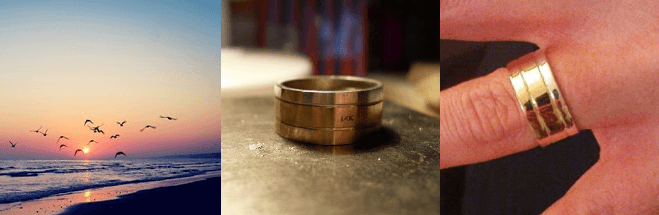
I worked with the different natural colours of gilded in this committee to achieve a sunset graduation effect in this mixed metal wedding ring. The 14ct white gold layer (taken from an existing ring bought in Mexico) sits in the centre of the bluish-white toned silver layer above and the xanthous gold stripe below, acting as a mediator betwixt the ii opposing colours. In its original incarnation, the 14ct ring was Rhodium plated just this had worn abroad and formed the starting point for this remodelled blueprint.
These two rings were commissioned for twins as a gift from their mum and she opted for natural 9ct white gold as she liked the warm tone and to reduce the maintenance on them as they wouldn't need rhodium plating in the future.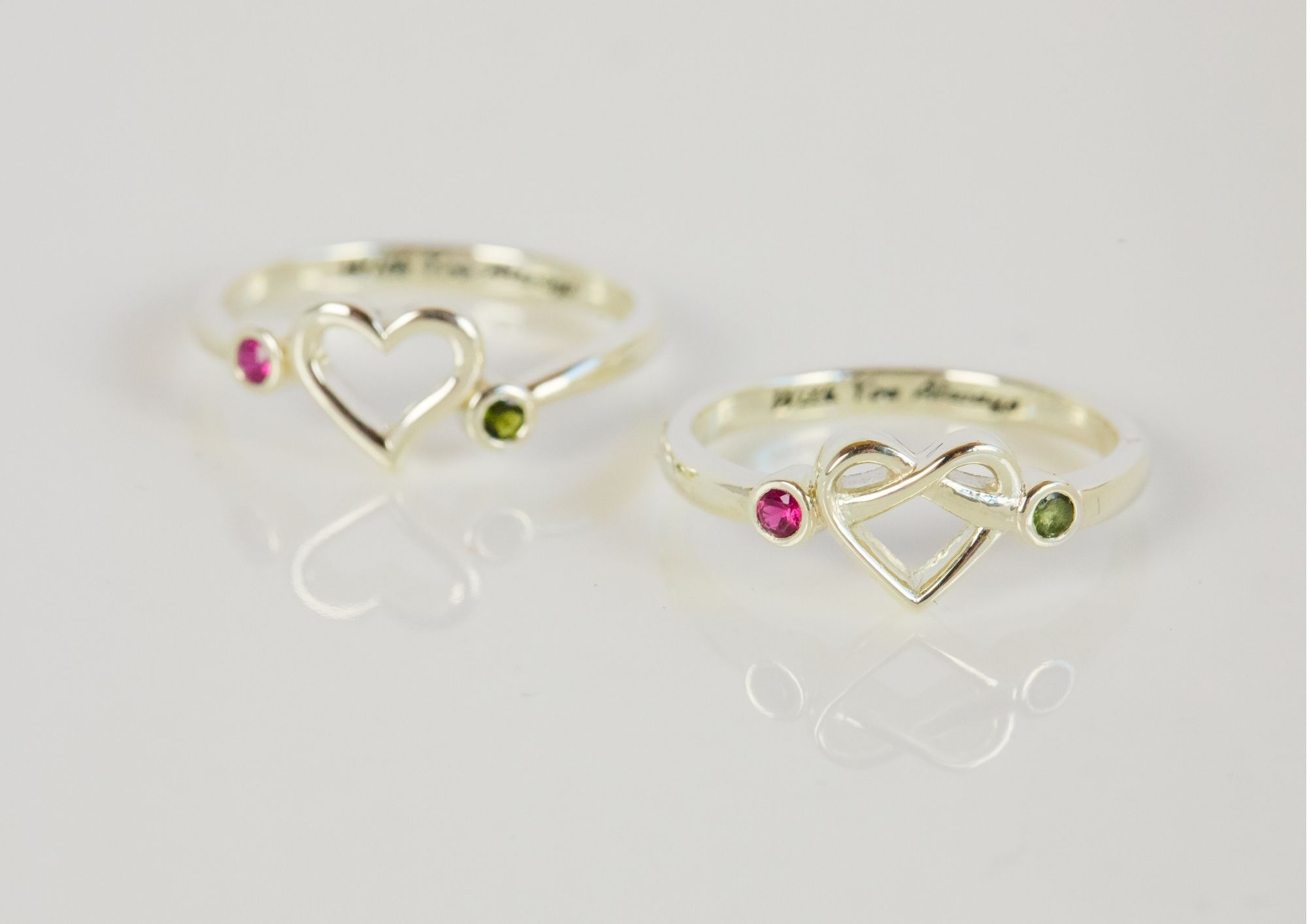
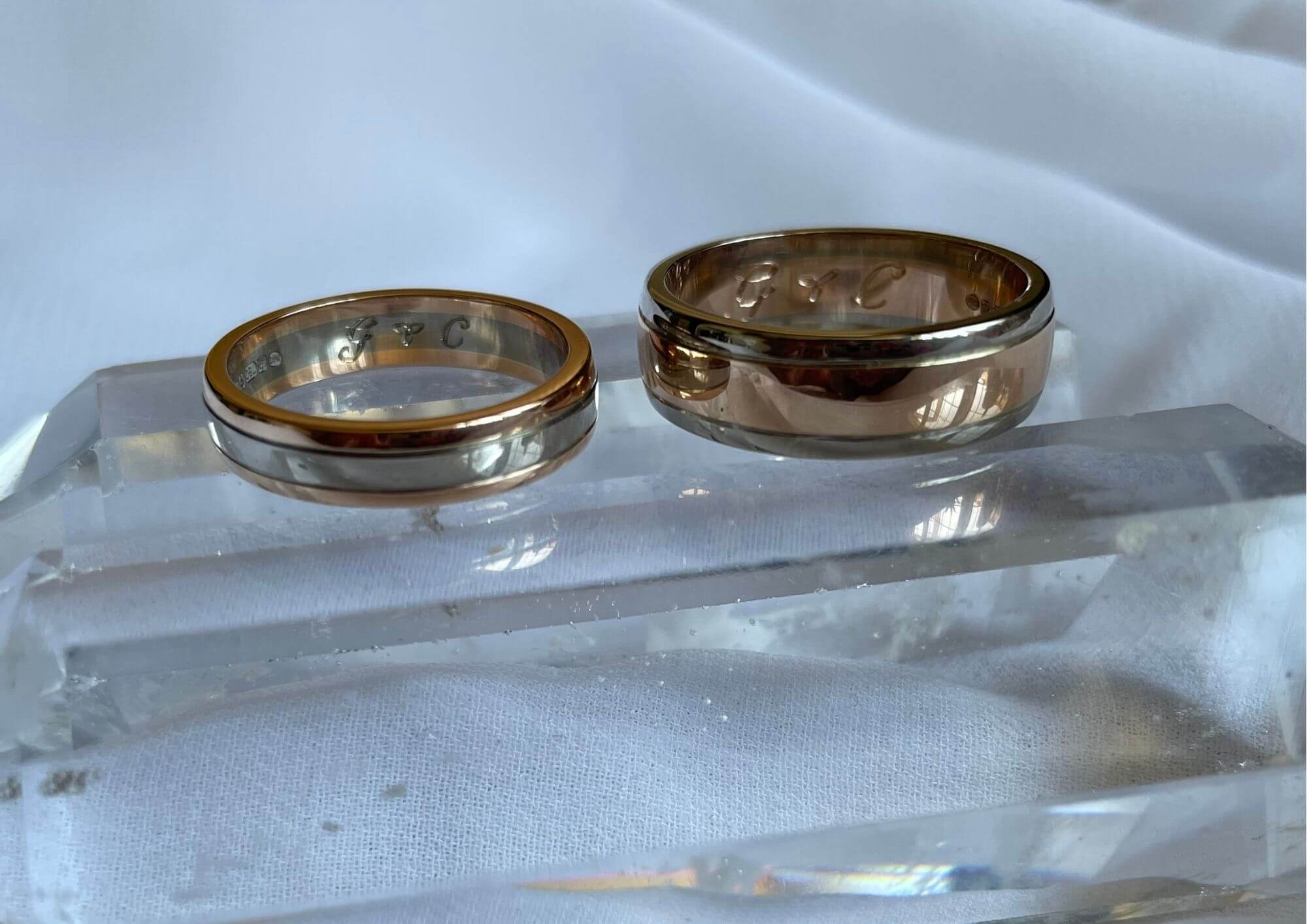
These wedding rings are made from 18ct white and rose golden, with no rhodium on the white gold. The warm tones of both metals complement each other perfectly. Rhodium plated white gold just wouldn't have the same effect next to the rose gold.
So to conclude…
In my opinion, white golden should be left in its natural country. I recollect the consumer should exist given the pick to plate it and they should most definitely have the opportunity to run into information technology in its natural form without the plating. Who knows, more people might larn to honey the warmer, darker colours of united nations-plated white gilded similar I do!
Leaving white gilt au naturel would give more of a rainbow option of white precious metals when information technology comes to bespoke jewellery. Clients tin can select which metallic suits their peel tone; the colour of any stones included in the design, and of grade, their budget.
Paradigm credit: Krikawa
I believe that everyone should have the option to brand their ain decisions on plating rather than it being thrust on them equally a thing of class. In that location is simply not enough education available to general public on the high street and it frustrates me that and then many people are left feeling negatively towards the jewellery manufacture. They may feel they have been deceived when the plating on their jewellery starts to wear and the truthful color of the metallic is slowly revealed. I say let'southward motion abroad from this bling-tastic civilization and let's give consumers the correct to brand their own decisions based on the facts.
And finally…
To truly bulldoze home my point, hither are four gorgeous white aureate rings without Rhodium plating by some of my favourite jewellery designers:
1. How utterly scrumptious is this chocolate diamond solitaire past Mirri Damer? The warm, cognac toned brown of the diamond compliments the gunmetal hue of the 18ct white gold beautifully. The soft texture Mirri works into the surface of the metal emphasises the warm tone of the gold and compliments the diamond exquisitely.
2. What I like near this mixed metal wedding ring past leading contemporary German jewellery brand, Niessing, is how the mix of white golden and Platinum demonstrates the different color tones so well. In their words, the contrasting coloured metals "run along the ring like a vein of stone along a pebble, both visible and palpable." Merely stunning!

3. This highly textured wedding ring by Karen Karch shows off the natural colour of white golden so well because of its width. I dear how she uses texture for an honest hand-hewn terminate rather than trying to attain a machine like finish; it almost looks soft and malleable.

4. American make, Greenwich Jewelers, have utilised the natural colour of white golden beautifully to dissimilarity the intriguingly shaped diamond in the heart of the design. The invisibly set up diamonds in the shoulder of the ring stand up out as well considering of this contrast in tone. If the ring was Rhodium plated, they would all but disappear into a body of water of icy white metal.

How do you feel about Rhodium plating? Let us know in the annotate field beneath.
Alternatively, if y'all're in the market place for a bespoke jewellery blueprint, do consider getting in touch on. I work closely with my clients to design bespoke nuptials rings, bespoke engagement rings and all other manner of beautfiful jewellery.
Source: https://www.jodiegearing.com/white-gold-should-not-be-rhodium-plated/
0 Response to "Make White Gold Look New Again Real White Gold Vs Rhodium"
Post a Comment