Where Did Okonkwo Take His Family to Live
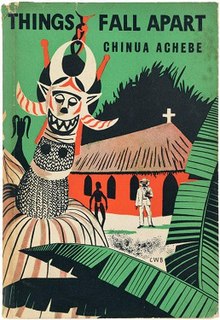 First edition | |
| Author | Chinua Achebe |
|---|---|
| Country | Nigeria |
| Language | English |
| Publisher | William Heinemann Ltd. |
| Publication date | 1958 |
Things Autumn Apart is the debut novel past Nigerian author Chinua Achebe, first published in 1958. It depicts pre-colonial life in the southeastern part of Nigeria and the invasion past Europeans during the late 19th century. Information technology is seen equally the archetypal mod African novel in English, and ane of the commencement to receive global critical acclaim. It is a staple book in schools throughout Africa and is widely read and studied in English-speaking countries around the earth. The novel was beginning published in the UK in 1962 by William Heinemann Ltd, and became the first work published in Heinemann'due south African Writers Series.
The novel follows the life of Okonkwo, an Igbo ("Ibo" in the novel) human being and local wrestling champion in the fictional Nigerian clan of Umuofia. The piece of work is split into three parts, with the first describing his family, personal history, and the customs and club of the Igbo, and the second and third sections introducing the influence of European colonialism and Christian missionaries on Okonkwo, his family, and the wider Igbo community.
Things Fall Apart was followed by a sequel, No Longer at Ease (1960), originally written equally the 2nd role of a larger work along with Arrow of God (1964). Achebe states that his two later novels A Homo of the People (1966) and Anthills of the Savannah (1987), while not featuring Okonkwo'due south descendants, are spiritual successors to the previous novels in chronicling African history.
Plot [edit]
Role 1 [edit]
The novel's protagonist, Okonkwo, is famous in the villages of Umuofia for being a wrestling champion, defeating a wrestler nicknamed "Amalinze The Cat" (considering he never lands on his back). Okonkwo is strong, hard-working, and strives to show no weakness. He wants to dispel his father Unoka's tainted legacy of unpaid debts, a neglected wife and children, and cowardice at the sight of blood. Okonkwo works to build his wealth entirely on his own, every bit Unoka died a shameful expiry and left many unpaid debts. He is also obsessed with his masculinity, and whatsoever slight compromise to this is swiftly destroyed. As a result, he often beats his wives and children, and is unkind to his neighbours. All the same, his drive to escape the legacy of his father leads him to be wealthy, courageous, and powerful amongst the people of his hamlet. He is a leader of his hamlet, having attained a position in his society for which he has striven all his life.[1]
Okonkwo is selected by the elders to exist the guardian of Ikemefuna, a male child taken by the clan as a peace settlement betwixt Umuofia and some other association after Ikemefuna's male parent killed an Umuofian woman. The boy lives with Okonkwo's family and Okonkwo grows addicted of him, although Okonkwo does not testify his fondness so as not to announced weak. The boy looks up to Okonkwo and considers him a second begetter. The Oracle of Umuofia somewhen pronounces that the boy must be killed. Ezeudu, the oldest man in the village, warns Okonkwo that he should take nothing to do with the murder because information technology would exist like killing his own kid – but to avoid seeming weak and feminine to the other men of the village, Okonkwo disregards the warning from the former human being, striking the killing blow himself even equally Ikemefuna begs his "father" for protection. For many days subsequently killing Ikemefuna, Okonkwo feels guilty and saddened.
Shortly after Ikemefuna's death, things begin to get wrong for Okonkwo. He falls into a great depression, as he has been greatly traumatized by the act of murdering his own adopted son. His sickly daughter Ezinma falls unexpectedly ill and information technology is feared she may die; during a gun salute at Ezeudu'due south funeral, Okonkwo's gun accidentally explodes and kills Ezeudu'due south son. He and his family are exiled to his motherland, the nearby village Mbanta, for seven years to appease the gods he has offended.
Part 2 [edit]
While Okonkwo is away in Mbanta, he learns that white men are living in Umuofia with the intent of introducing their religion, Christianity. As the number of converts increases, the foothold of the white people grows and a new government is introduced.[2] The village is forced to answer with either appeasement or resistance to the imposition of the white people'south nascent society. Okonkwo's son Nwoye starts getting curious about the missionaries and the new faith. After he is beaten past his father for the concluding time, he decides to leave his family unit behind and alive independently. He wants to exist with the missionaries because his beliefs have changed while being introduced to Christianity by Mr. Dark-brown. In the last yr of his exile, Okonkwo instructs his best friend Obierika to sell all of his yams and hire two men to build him two huts so he can have a house to get back to with his family. He also holds a bang-up feast for his female parent's kinsmen, where an elderly attendee bemoans the current state of their tribe and its future.
Part 3 [edit]
Returning from exile, Okonkwo finds his hamlet changed by the presence of the white men. Later on a catechumen commits an evil deed by unmasking an elderberry as he embodies an ancestral spirit of the association, the village retaliates by destroying a local Christian church. In response, the District Commissioner representing the colonial regime takes Okonkwo and several other native leaders prisoner awaiting payment of a fine of two hundred bags of cowries. Despite the District Commissioner's instructions to treat the leaders of Umuofia with respect, the native "court messengers" humiliate them, doing things such as shaving their heads and whipping them. As a result, the people of Umuofia finally assemble for what could be a great uprising. Okonkwo, a warrior by nature and adamant about following Umuofian custom and tradition, despises whatsoever form of cowardice and advocates state of war against the white men. When messengers of the white government endeavor to cease the coming together, Okonkwo beheads one of them. Because the oversupply allows the other messengers to escape and does non fight alongside Okonkwo, he realizes with despair that the people of Umuofia are not going to fight to protect themselves – his society's response to such a conflict, which for so long had been anticipated and dictated by tradition, is irresolute. The District Commissioner Gregory Irwin then comes to Okonkwo's house to take him to court, he finds that Okonkwo has hanged himself to avoid beingness tried in a colonial courtroom. Amidst his own people, Okonkwo's actions have tarnished his reputation and condition, as information technology is strictly confronting the teachings of the Igbo to commit suicide. Every bit Irwin and his men prepare to coffin Okonkwo, Irwin muses that Okonkwo'due south expiry will make an interesting affiliate for his written book: "The Pacification of the Primitive Tribes of the Lower Niger."
Characters [edit]
- Okonkwo, the protagonist, has three wives and x (total) children and becomes a leader of his clan. His father, Unoka, was weak and lazy, and Okonkwo resents him for his weaknesses: he enacts traditional masculinity. Okonkwo strives to make his mode in a civilisation that traditionally values manliness.
- Ekwefi is Okonkwo'southward second wife. Although she falls in love with Okonkwo after seeing him in a wrestling lucifer, she marries some other man considering Okonkwo is as well poor to pay her bride cost at that time. Two years later, she runs abroad to Okonkwo'due south compound one night and later on marries him. She receives severe beatings from Okonkwo just similar his other wives; but unlike them, she is known to talk back to Okonkwo.
- Unoka is Okonkwo'due south father, who defied typical Igbo masculinity by neglecting to grow yams, accept care of his wives and children, and pay his debts earlier he dies.
- Nwoye is Okonkwo'due south son, about whom Okonkwo worries, fearing that he will get like Unoka. Similar to Unoka, Nwoye does not subscribe to the traditional Igbo view of masculinity existence equated to violence; rather, he prefers the stories of his mother. Nwoye connects to Ikemefuna, who presents an alternative to Okonkwo's rigid masculinity. He is ane of the early converts to Christianity and takes on the Christian name Isaac, an act which Okonkwo views equally a last betrayal.
- Ikemefuna is a male child from the Mbaino tribe. His father murders the wife of an Umuofia man, and in the resulting settlement of the matter, Ikemefuma is put into the care of Okonkwo. By the decision of Umuofia regime, Ikemefuna is ultimately killed, an human activity which Okonkwo does non prevent, and fifty-fifty participates in, lest he seems feminine and weak. Ikemefuna became very close to Nwoye, and Okonkwo's decision to participate in Ikemefuna's expiry takes a cost on Okonkwo's relationship with Nwoye.
- Ezinma is Okonkwo'due south favorite daughter and the only kid of his married woman Ekwefi. Ezinma, the Crystal Beauty, is very much the antithesis of a normal woman inside the culture and Okonkwo routinely remarks that she would've made a much better boy than a girl, even wishing that she had been born every bit one. Ezinma often contradicts and challenges her father, which wins his adoration, affection, and respect. She is very like to her father, and this is fabricated credible when she matures into a beautiful immature woman who refuses to marry during her family's exile, instead choosing to help her father regain his identify of respect within society.
- Obierika is Okonkwo's all-time friend from Umuofia. Dissimilar Okonkwo, Obierika thinks earlier he acts and is, therefore, less violent and arrogant than Okonkwo. He is considered the voice of reason in the book, and questions certain parts of their culture, such as the necessity to exile Okonkwo after he unintentionally kills a boy. Obierika's own son, Maduka, is greatly admired by Okonkwo for his wrestling prowess.
- Ogbuefi Ezeudu is 1 of the elders of Umuofia.
- Mr. Brown is an English language missionary who comes to Umuofia. He shows kindness and compassion towards the villagers and makes an endeavour to understand the Igbo beliefs.
- Mr. Smith is some other English missionary sent to Umuofia to supercede Mr. Brown later he falls ill. In stark contrast to his predecessor, he remains strict and zealous towards the Africans.
Groundwork [edit]
The title is a quotation from "The Second Coming", a verse form by W. B. Yeats.
Most of the story takes place in the fictional village of Iguedo, which is in the Umuofia clan. The place name Iguedo is only mentioned 3 times in the novel. Achebe more oftentimes uses the proper noun Umuofia to refer to Okonkwo's home hamlet of Iguedo. Umuofia is located west of the actual city of Onitsha, on the east banking company of the Niger River in Nigeria. The events of the novel unfold in the 1890s.[3] The civilisation depicted, that of the Igbo people, is similar to that of Achebe's birthplace of Ogidi, where Igbo-speaking people lived together in groups of independent villages ruled past titled elders. The customs described in the novel mirror those of the bodily Onitsha people, who lived near Ogidi, and with whom Achebe was familiar.
Within forty years of the colonization of Nigeria, by the time Achebe was born in 1930, the missionaries were well established. He was influenced by Western civilization but he refused to modify his Igbo proper noun Chinua to Albert. Achebe'southward father Isaiah was among the beginning to be converted in Ogidi, around the turn of the century. Isaiah Achebe himself was an orphan raised by his grandfather. His granddaddy, far from opposing Isaiah's conversion to Christianity, allowed his Christian marriage to be celebrated in his compound.[3]
Language option [edit]
Achebe wrote his novels in English because the written standard Igbo language was created by combining various dialects, creating a stilted written form. In a 1994 interview with The Paris Review, Achebe said, "the novel grade seems to get with the English language. At that place is a problem with the Igbo language. It suffers from a very serious inheritance which it received at the outset of this century from the Anglican mission. They sent out a missionary past the proper name of Dennis. Archdeacon Dennis. He was a scholar. He had this notion that the Igbo linguistic communication—which had very many different dialects—should somehow manufacture a uniform dialect that would be used in writing to avoid all these different dialects. Because the missionaries were powerful, what they wanted to practice they did. This became the law. But the standard version cannot sing. At that place's nothing you lot can do with it to make information technology sing. It'due south heavy. It's wooden. It doesn't get anywhere."[iv]
Achebe's option to write in English language has acquired controversy. While both African and non-African critics agree that Achebe modelled Things Autumn Apart on classic European literature, they disagree nigh whether his novel upholds a Western model, or, in fact, subverts or confronts it.[5] Achebe continued to defend his decision: "English language is something you spend your lifetime acquiring, so it would be foolish not to use information technology. Also, in the logic of colonization and decolonization it is actually a very powerful weapon in the fight to regain what was yours. English was the language of colonization itself. It is not but something y'all employ because yous have it anyway."[half-dozen]
Achebe is noted for his inclusion of and weaving in of proverbs from Igbo oral culture into his writing.[7] This influence was explicitly referenced by Achebe in Things Fall Apart: "Among the Igbo the fine art of conversation is regarded very highly, and proverbs are the palm-oil with which words are eaten."
Literary significance and reception [edit]
Things Autumn Apart is regarded every bit a milestone in African literature. It has come up to exist seen as the archetypal mod African novel in English,[3] [half-dozen] and is read in Nigeria and throughout Africa. It is studied widely in Europe, India, and North America, where it has spawned numerous secondary and tertiary analytical works. It has achieved similar status and repute in Australia and Oceania.[8] [3] Considered Achebe's magnum opus, it has sold more than 20 1000000 copies worldwide.[9] Fourth dimension magazine included the novel in its Time 100 Best English-language Novels from 1923 to 2005.[10] The novel has been translated into more than 50 languages, and is oft used in literature, world history, and African studies courses beyond the world.
Achebe is at present considered to be the essential novelist on African identity, nationalism, and decolonization. Achebe'south main focus has been cultural ambiguity and contestation. The complexity of novels such every bit Things Fall Apart depends on Achebe's ability to bring competing cultural systems and their languages to the aforementioned level of representation, dialogue, and contestation.[6]
Reviewers have praised Achebe'southward neutral narration and have described Things Fall Apart as a realistic novel. Much of the critical word about Things Fall Apart concentrates on the socio-political aspects of the novel, including the friction betwixt the members of Igbo society as they confront the intrusive and overpowering presence of Western government and beliefs. Ernest N. Emenyonu commented that "Things Autumn Autonomously is indeed a classic report of cantankerous-cultural misunderstanding and the consequences to the residual of humanity, when a argumentative culture or civilization, out of sheer arrogance and ethnocentrism, takes it upon itself to invade another culture, some other civilisation."[xi]
Achebe's writing about African society, in telling from an African bespeak of view the story of the colonization of the Igbo, tends to extinguish the conception that African culture had been savage and primitive. In Things Fall Autonomously, western culture is portrayed as existence "big-headed and ethnocentric," insisting that the African civilisation needed a leader. Equally it had no kings or chiefs, Umuofian civilisation was vulnerable to invasion past western civilisation. It is felt that the repression of the Igbo language at the end of the novel contributes greatly to the destruction of the civilization. Although Achebe favours the African culture of the pre-western society, the writer attributes its destruction to the "weaknesses within the native construction." Achebe portrays the culture equally having a religion, a government, a system of money, and an creative tradition, equally well as a judicial system.[12]
Influence and legacy [edit]
The publication of Achebe'due south Things Autumn Apart helped pave the way for numerous other African writers. Novelists who published after Achebe were able to find an eloquent and effective mode for the expression of the item social, historical, and cultural state of affairs of modern Africa.[5] Before Things Fall Apart was published, most of the novels about Africa had been written by European authors, portraying Africans as savages who were in demand of western enlightenment.
Achebe broke from this outsider view, by portraying Igbo society in a sympathetic calorie-free. This allows the reader to examine the furnishings of European colonialism from a unlike perspective.[v] He commented: "The popularity of Things Autumn Apart in my own society can be explained simply ... this was the offset time we were seeing ourselves, as autonomous individuals, rather than half-people, or every bit Conrad would say, 'rudimentary souls'."[6] Nigerian Nobel laureate Wole Soyinka has described the work as "the first novel in English language which spoke from the interior of the African character, rather than portraying the African as an exotic, every bit the white man would see him."[thirteen]
The linguistic communication of the novel has non only intrigued critics but has also been a major factor in the emergence of the modern African novel. Because Achebe wrote in English, portrayed Igbo life from the point of view of an African man, and used the language of his people, he was able to profoundly influence African novelists, who viewed him as a mentor.[6]
Achebe's fiction and criticism continue to inspire and influence writers effectually the world. Hilary Mantel, the Booker Prize-winning novelist in a 7 May 2012 article in Newsweek, "Hilary Mantel'southward Favorite Historical Fictions", lists Things Fall Apart as ane of her five favourite novels in this genre. A whole new generation of African writers – Caine Prize winners Binyavanga Wainaina (current director of the Chinua Achebe Center at Bard College) and Helon Habila (Waiting for an Angel [2004] and Measuring Time [2007]), as well as Uzodinma Iweala (Beasts of No Nation [2005]), and Professor Okey Ndibe (Arrows of Pelting [2000]) count Chinua Achebe as a significant influence. Chimamanda Ngozi Adichie, the author of the pop and critically acclaimed novels Purple Hibiscus (2003) and Half of a Xanthous Sun (2006), commented in a 2006 interview: "Chinua Achebe volition always exist important to me because his piece of work influenced non so much my fashion equally my writing philosophy: reading him emboldened me, gave me permission to write about the things I knew well."[6]
Things Fall Apart was listed by Encyclopædia Britannica as ane of "12 Novels Considered the 'Greatest Book Ever Written'".[14]
The 60th ceremony of the kickoff publication of Things Fall Apart was celebrated at the S Bank Centre in London, U.k., on fifteen Apr 2018 with live readings from the book by Femi Elufowoju Jr, Adesua Etomi, Yomi Sode, Lucian Msamati, Jennifer Nansubuga Makumbi, Chibundu Onuzo, Ellah Wakatama Allfrey, Ben Okri, and Margaret Busby.[xv] [16]
On November 5, 2019, the BBC News listed Things Fall Apart on its list of the 100 virtually influential novels.[17]
Film, television set, music and theatrical adaptations [edit]
A radio drama chosen Okonkwo was made of the novel in April 1961 by the Nigerian Broadcasting Corporation. Information technology featured Wole Soyinka in a supporting function.[18]
In 1970, the novel was made into a film starring Princess Elizabeth of Toro, Johnny Sekka and Orlando Martins by Francis Oladele and Wolf Schmidt, executive producers Hollywood lawyer Edward Mosk and his married woman Fern, who wrote the screenplay. Directed by Jason Pohland.[nineteen] [Flimportal 1]
In 1987, the book was made into a very successful miniseries directed by David Orere and circulate on Nigerian television by the Nigerian Tv set Authority. It starred several established film actors, including Pete Edochie, Nkem Owoh, and Sam Loco Efe.[20]
In 1999, the American hip-hop ring The Roots released their fourth studio anthology Things Fall Apart in reference to Achebe's novel. A theatrical production of Things Fall Autonomously, adjusted by Biyi Bandele, took identify at the Kennedy Centre that year besides.[21]
In 2019, the lyrics of "No Holiday for Madiba", a song honoring Nelson Mandela include the phrase, "things autumn apart", in reference to the book'south title.
Publication information [edit]
- Achebe, Chinua. The African Trilogy. (London: Everyman'southward Library, 2010) ISBN 9781841593272. Edited with an introduction by Chimamanda Ngozi Adichie. The book collects Things Fall Apart, No Longer at Ease, and Arrow of God in 1 volume.
See also [edit]
- Heart of Darkness
References [edit]
- ^ Irele, F. Abiola, "The Crisis of Cultural Memory in Chinua Achebe's Things Fall Apart", African Studies Quarterly, Volume 4, Issue iii, Autumn 2000, pp. ane–40.
- ^ Smuthkochorn, Sutassi (2013). "Things Fall Apart". Journal of the Humanities. 31: 1–2.
- ^ a b c d Kwame Anthony Appiah (1992), "Introduction" to the Lowest'south Library edition.
- ^ Brooks, Jerome, "Chinua Achebe, The Art of Fiction No. 139", The Paris Review No. 133 (Winter 1994).
- ^ a b c Booker (2003), p. seven.
- ^ a b c d e f Sickels, Amy. "The Critical Reception of Things Fall Autonomously", in Booker (2011).
- ^ Jayalakshmi V. Rao, Mrs A. V. North. Higher, "Saying and Civilisation in the Novels of Chinua Achebe", African Postcolonial Literature in English.
- ^ admin (2015-11-xvi). "Chinua Achebe". BOOK OF DAYS TALES . Retrieved 2020-ten-eighteen .
- ^ THINGS Autumn APART past Chinua Achebe | PenguinRandomHouse.com.
- ^ "All-Fourth dimension 100 Novels| Full list", Time, 16 October 2005.
- ^ Whittaker, David, "Chinua Achebe's Things Autumn Apart", New York, 2007, p. 59.
- ^ Achebe, Chinua (1994). Things Fall Apart. London: Penguin Books. pp. 8. ISBN0385474547.
- ^ The Periodical of Blacks in Higher Education 2001, pp. 28–29.
- ^ Hogeback, Jonathan, "12 Novels Considered the 'Greatest Book Always Written'", Encyclopædia Britannica.
- ^ Murua, James, "Chinua Achebe'due south 'Things Autumn Apart' at 60 celebrated", James Murua's Literature Blog, 24 April 2018.
- ^ Hewitt, Eddie, "Brnging Achebe's Masterpiece to Life", Brittle Paper, 24 April 2018.
- ^ "100 'well-nigh inspiring' novels revealed past BBC Arts". BBC News. 2019-eleven-05. Retrieved 2019-11-x .
The reveal kickstarts the BBC'due south yr-long celebration of literature.
- ^ Ezenwa-Ohaeto (1997). Chinua Achebe: A Biography Bloomington: Indiana University Printing, p. 81. ISBN 0-253-33342-iii.
- ^ David Chioni Moore, Analee Heath and Chinua Achebe (2008). "A Conversation with Chinua Achebe". Transition. 100 (100): 23. JSTOR 20542537.
- ^ "African movies direct and entertainment online". www.africanmoviesdirect.com . Retrieved 10 December 2017.
- ^ Triplett, William (1999-02-06). "1-Dimensional 'Things'". Washington Mail . Retrieved 2020-09-14 .
- Grouped References
- ^ Filmportal. "Things Fall Apart".
Sources [edit]
- "Chinua Achebe of Bard College". The Periodical of Blacks in Higher Educational activity. 33 (33): 28–29. Autumn 2001. doi:ten.2307/2678893. JSTOR 2678893.
Farther reading [edit]
- Achebe, Chinua. Things Autumn Apart. New York: Ballast Books, 1994. ISBN 0385474547
- Baldwin, Gordon. Strange Peoples and Stranger Community. New York: W. W. Norton and Company Inc, 1967.
- Booker, M. Keith. The Chinua Achebe Encyclopedia. Westport, Conn.: Greenwood Press, 2003. ISBN 978-0-325-07063-6
- Booker, One thousand. Keith. Things Fall Autonomously, by Chinua Achebe [Critical Insights]. Pasadena, Calif: Salem Press, 2011. ISBN 978-1-58765-711-5
- Frazer, Sir James George. The Golden Bough: A Study in Magic and Religion. New York: The Macmillan Visitor, 1942.
- Girard, Rene. Violence and the Sacred. Trans. Patrick Gregory. Baltimore: Johns Hopkins University Press, 1977. ISBN 0-8018-1963-6
- Islam, Dr.. Manirul. Chinua Achebe's 'Things Fall Autonomously' and 'No Longer at Ease': Disquisitional Perspectives. Deutschland: Lambert Academic Publishing, 2019. ISBN 978-620-0-48315-vii
- Rhoads, Diana Akers (September 1993). "Culture in Chinua Achebe's Things Fall Apart". African Studies Review. 36(two): 61–72.
- Roberts, J. M. A Short History of the World. New York: Oxford University Press, 1993.
- Rosenberg, Donna. World Mythology: An Album of the Great Myths and Epics. Lincolnwood, Illinois: NTC Publishing Grouping, 1994. ISBN 978-0-8442-5765-5
External links [edit]
- Chinua Achebe discusses Things Autumn Apart on the BBC World Book Club
- Teacher's Guide at Random House
- A "New English" in Chinua Achebe'due south Things Fall Apart
- Written report Resource for writing about Things Fall Apart
- Written report guide
- Words nowadays in the novel used in past SATs. Includes definitions, words in club from the book, and three unlike tests.
- Things Fall Apart Reviews
- Things Autumn Apart on Wiki Summaries
- Things Autumn Apart study guide, themes, analysis, instructor resources
- Things Fall Apart Igbo Culture Guide, Igbo Proverbs
- Things Fall Apart Summary
Source: https://en.wikipedia.org/wiki/Things_Fall_Apart
0 Response to "Where Did Okonkwo Take His Family to Live"
Post a Comment